
Tirohanga Whānui | Overview
The New Zealand Council of Christian Social Services (NZCCSS) welcomes the opportunity to provide feedback on the Residential Tenancies (Registration of Boarding House Landlords) Amendment Bill. We strongly support the kaupapa to introduce a register of boarding houses and their landlords. NZCCSS receives insights regarding the issues around boarding house conditions that are faced by communities through our member organisations and the Better Boarding Housing Network. The Better Boarding House Network is a group of both member and external organisations working in the housing space and/or directly supporting clients who live in boarding houses, which was established to gain greater understanding of the issues these tenants face and advocate for better conditions in boarding houses. We are aware of boarding houses which offer secure and healthy housing options for their tenants, and we strongly believe that this legislation is a good first step to improving the conditions of boarding houses throughout Aotearoa. While we strongly support this legislation, we believe that the offence for breaching these requirements should be increased, there is a need for minimum education requirements and that this bill provides a valuable opportunity to update the definition of boarding house tenancy to add protections to boarding house tenants experiencing severe housing deprivation.
Taunakitanga | Recommendations
We raise the following points and recommendations for consideration:
Item One: We strongly support the amendment to the RTA to introduce a requirement for registration of boarding houses and their landlords.
NZCCSS strongly supports the introduction of boarding house register. There is currently a lack of available data regarding the number or size of boarding houses in Aotearoa. The 2018 census estimated there were 243 boarding houses (Statistics New Zealand, 2025), however in the same period MBIE estimated this as 548 (Stock, 2018). The 2023 census reported 372 boarding houses (Statistics New Zealand, 2025) but MBIE figures from 2023 put this at over 800 (Rashbrooke, 2024). The implementation of a boarding house register offers increased transparency regarding the size and location of boarding houses in Aotearoa and would improve the ability of MBIE and councils to audit these and ensure they meet Healthy Homes and Building standards.
Member organisations continue to raise issues faced by clients they support regarding both the quality and cost of rooms in boarding houses. While Boarding houses are required to comply with the Healthy Homes Standards as of 1 July 2021 (Tenancy Services, 2025), many continue to be available which do not meet these. Additionally, inspections by MBIE following the Loafers Lodge fire continue to find boarding houses that are not meeting the warrant of fitness requirements (Williams, August 2025). Members report that boarding house tenants are paying up to $340-450/week for a room with shared facilities. This is not much less than renting a 2–3-bedroom house or apartment in many regions and for tenants who are often reliant on income support this leaves very little money to cover other living costs.
Recommendation One: We recommend the implementation of a boarding house register to allow
better transparency around boarding houses in Aotearoa and ensure that these meet healthy homes
and building standards.
Item Two: Updating the definition of a boarding house tenancy would provide protections for those experiencing severe housing deprivation and allow a pathway to more permanent housing options.
The Ministry of Social Development Risk rating for assessment of eligibility for social housing currently categorises those living in a boarding house as low or no need (MSD, n.d.):
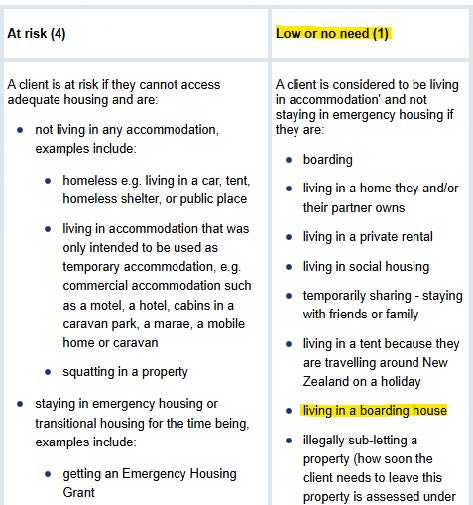
While we acknowledge that some boarding houses can and do provide suitable accommodation for tenants long-term, this is not always the case and we know that for many boarding houses are deemed as a last resort and a temporary housing solution (Aspinall, 2013 & Williams, June 2025). In line with this risk rating, feedback from member organisations and the Better Boarding House Network facilitated by NZCCSS indicates that tenancy in a boarding house often results in removal from the housing register. This leaves people for whom a boarding house was designed to be a stop gap, with limited access to more long-term and secure housing options.
Additionally, the classification of people living in boarding houses as being low or no need for social housing conflicts with the New Zealand Definition of Homelessness (Statistics New Zealand, 2014), which defines boarding houses as ‘temporary accommodation’ and states that “these are not intended for long-term accommodation”.
The current definition of a boarding house tenancy means a residential tenancy in a boarding house:
(a) that is intended to, or that does in fact, last for 28 days or more; and
(b) under which the tenant is granted exclusive rights to occupy particular sleeping quarters in
the boarding house, and has the right to the shared use of the facilities of the boarding house
We believe that this definition should be amended to reflect the New Zealand Definition of
Homelessness and ensure that while people are able to choose to reside in a boarding house longterm, boarding house tenancy does not provide a barrier to accessing more long-term housing options and that they can remain on the housing register.
We propose amending the definition to the following:
boarding house tenancy means a residential tenancy in a boarding house:
(a) that while deemed temporary, is intended to, or that does in fact, last for 28 days or more; and
(b) under which the tenant is granted exclusive rights to occupy particular sleeping quarters in
the boarding house, and has the right to the shared use of the facilities of the boarding house;
and
(c) under which the tenant is still considered at risk under housing assessments for social housing
Recommendation Two: We strongly recommend that the definition of boarding house tenancy is
updated to reflect the temporary nature of most boarding house tenancies and prevent tenants being
removed from the housing register.
Item Three: Proposed fines should be increased in line with other fines faced by boarding house
landlords for breaching RTA obligations.
We support the inclusion of the proposed fines in section 66ZP, however, feel these should be
increased to bring them in line with the pecuniary penalties of up to $50,000 which MBIE is able to
seek for boarding house landlords who intentionally fail to meet their obligations under the
Residential Tenancies Act 1986 (Tenancy Services, 2026).
Recommendation Three: We recommend increasing the fines proposed in section to 66ZP to up to
$50,000 in line with similar fines for breaching the RTA obligations.
Item Four: The introduction of minimum education requirements would help to ensure that
boarding house landlords understand their legal and regulatory obligations
We would strongly support the inclusion of minimum education requirements in line with what is
proposed for the Residential Property Managers Registration Bill (MHUD, 2026a). Introducing
minimum education requirements would ensure that boarding house landlords understand the laws
and regulations they have to abide by. Similarly to what is proposed for the Residential Property
Managers Registration Bill (MHUD, 2026b), the register should outline the education requirements
and what this means for renewal of registration. Refreshment of education particularly in
circumstances where there are updates to the requirements must be clearly outlined.
Recommendation Four: We recommend introducing education requirements to support boarding
house landlords to understand their obligations.
Overall recommendation: We strongly recommend that this Bill be passed.
Ngā Tohutoro | References
Aspinall, C. (2013). Anyone can live in a boarding house, can’t they? The advantages and
disadvantages of boarding houses. [Master’s thesis, University of Otago, Wellington NZ]
Ministry of Social Development (MSD). (n.d.). Risk rating for clients not living in any accommodation,
including emergency housing or transitional housing. Work and Income.
https://www.workandincome.govt.nz/map/social-housing/assessment-of-eligibility/risk-ratingfor-clients-not-living-in-any-accommodation-including-emergency-housing-or-transitionalhousing
Rashbrooke, M. (May 2024). One year ago, a deadly boarding house fire shook New Zealand.
We must prevent another tragedy. The Guardian.
www.theguardian.com/world/article/2024/may/16/one-year-ago-a-deadly-boardinghouse-
fire-shook-new-zealand-we-must-prevent-another-tragedy
Statistics New Zealand. (2014). New Zealand definition of homelessness: update.
www.stats.govt.nz/assets/Uploads/Retirement-of-archive-website-projectfiles/
Methods/New-Zealand-definition-of-homelessness/nz-definition-homelessness-2015-
update.pdf
Statistics New Zealand. (2025). Housing in Aotearoa New Zealand: 2025.
www.stats.govt.nz/reports/housing-in-aotearoa-new-zealand-2025/
Stock, R. (August 2018). Government plans to change the boarding house rules. Stuff.
www.stuff.co.nz/business/106590207/government-plans-to-change-the-boarding-houserules
Tenancy Services. (2026). Enforcement measures for the regulator.
www.tenancy.govt.nz/disputes/breaches-of-the-residential-tenancies-act/enforcementmeasures/
Tenancy Services. (2025). Healthy homes compliance. www.tenancy.govt.nz/healthyhomes/
healthy-homes-compliance/
Williams, A. (June 2025). Fears of a state house blacklist: ‘You’ll never get back in to that level’.
www.rnz.co.nz/news/political/563509/fears-of-a-state-house-blacklist-you-ll-never-getback-
in-to-that-level
Williams, A. (August 2025). Hundreds of otherwise homeless turning to unsafe boarding
houses, social services warn. RNZ. www.rnz.co.nz/news/national/570484/hundreds-ofotherwise-homeless-turning-to-unsafe-boarding-houses-social-services-warn
Ingoa whakapā | Contact Name
Alicia Sudden ceo@nzccss.org.nz
Dr Katie Schraders